GEOTECHNICAL ENGINEERING
PORTLAOISE
HomeLaboratoryLaboratory CBR test

Laboratory CBR Testing for Pavement Design in Portlaoise

Practical geotechnics, field-tested.

LEARN MORE

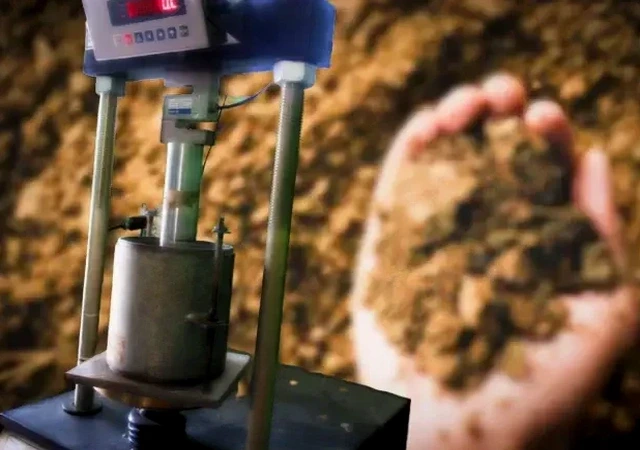
Portlaoise sits at approximately 140 metres above sea level on a landscape shaped by glacial deposits over Carboniferous limestone. Every new road widening, industrial yard, or residential access road in the town depends on one critical parameter: the bearing capacity of the compacted layer. Our laboratory CBR test provides that exact value under controlled moisture and density conditions, removing the variability that field testing sometimes introduces. For the past five years, earthworks contractors working on the Portlaoise Southern Bypass and local housing schemes have relied on our soaked CBR results to validate their pavement designs. The procedure follows I.S. EN 13286-47, with specimens compacted at optimum moisture content and submerged for 96 hours to replicate the worst groundwater scenario typical of the low-lying areas near the Triogue River. A single CBR figure can mean the difference between a 300 mm capping layer and a 500 mm one, with significant cost implications. When the subgrade shows marginal values, we often recommend complementing the CBR with a SPT drilling campaign to correlate dynamic penetration resistance with the soaked bearing ratio across the site.

A soaked CBR test in our Portlaoise lab compresses four days of worst-case groundwater conditions into a single design parameter that determines every centimetre of pavement thickness.
Our service areas

How we work

The glacial till beneath Portlaoise presents a particular challenge for CBR interpretation. Across the town, from the Mountmellick Road commercial area to the older estates near the railway station, the natural subgrade alternates between stiff boulder clay and softer laminated silts where the Triogue River has reworked the deposits. A CBR of 2% versus 5% in these two materials changes the entire pavement foundation design. Our laboratory procedure addresses this variability by compacting specimens at the Proctor density specified in the TII Earthworks Specification and then saturating them until swelling stabilises. The 96-hour soak is non-negotiable for Portlaoise because winter groundwater levels can rise to within 500 mm of formation level in the northern part of town. We record the swell-surcharge curve and the corrected penetration resistance, applying the standard force-penetration correction when the initial portion of the curve requires a zero adjustment. For projects where the soaked CBR falls below 2%, the design team typically needs to consider stone columns as ground improvement before placing the capping layer, or switch to a stabilised subgrade solution with lime or cement.
Laboratory CBR Testing for Pavement Design in Portlaoise
Technical reference — Portlaoise

Local ground factors

Sites on the western side of Portlaoise, near the Heath, sit on well-drained limestone till that consistently yields CBR values above 8% after soaking. Move two kilometres east toward the Triogue meadows, and the same compaction effort on laminated silts often produces soaked CBR figures below 3%. The contractor who treats both areas with the same pavement design will see premature rutting and edge cracking within the first two winters on the softer ground. The risk compounds when the laboratory CBR is skipped in favour of a visual assessment: a stiff-looking brown silt at formation level can lose 60% of its bearing capacity once saturated, a condition that only the 96-hour soak reveals. The I.S. EN 13286-47 protocol is explicit about reporting both the CBR value and the swell percentage because a soil that swells 4% during soaking exerts uplift pressures that can crack a bound base layer. In Portlaoise, where the average annual rainfall exceeds 800 mm and the winter water table stays high for months, the soaked CBR test is the single most cost-effective insurance against pavement failure on cohesive subgrades. Combining the CBR data with a CPT sounding along the alignment gives the designer a continuous profile of tip resistance and sleeve friction that contextualises the point-source CBR values.

Need a geotechnical assessment?

Reply within 24h.

Email: contact@geotechnical-engineering.co

Regulatory framework

I.S. EN 13286-47:2021 – Unbound and hydraulically bound mixtures – Part 47: Test method for the determination of California bearing ratio, immediate bearing index and linear swelling, I.S. EN 13286-2:2010 – Unbound and hydraulically bound mixtures – Part 2: Test methods for laboratory reference density and water content – Proctor compaction, TII Specification for Road Works, Series 600 – Earthworks (Transport Infrastructure Ireland), NRA HD 26/06 – Pavement and Foundation Design (legacy document, National Roads Authority), I.S. EN ISO 17892-12:2018 – Geotechnical investigation and testing – Laboratory testing of soil – Part 12: Determination of liquid and plastic limits (referenced for material classification prior to CBR)

Technical data

ParameterTypical value
Standard followedI.S. EN 13286-47:2021
Mould diameter152 mm (CBR mould)
Compactive effortStandard or Modified Proctor (I.S. EN 13286-2)
Soaking period (soaked test)96 hours under water
Surcharge mass during soakingEquivalent to pavement weight (typically 4.5 kg annular surcharge)
Penetration rate1.27 mm/min
Penetration readings reported at2.5 mm and 5.0 mm
Swell measurementDial gauge on tripod, reading every 24 h

Common questions

What does a laboratory CBR test cost in Portlaoise?

A standard soaked CBR test at our Portlaoise facility costs between €100 and €180 per specimen, depending on whether it is a single-point test or part of a three-point moisture suite. The price includes Proctor compaction, 96-hour soaking with swell monitoring, penetration testing, and the calculation report with corrected CBR values at 2.5 mm and 5.0 mm penetration.

How long does it take to get CBR results from the lab?

A soaked CBR test requires a minimum of five working days from sample receipt. Day one covers moisture conditioning and Proctor compaction. Days two through five are the 96-hour soaking period under surcharge, with daily swell readings. Penetration and the final report are completed on day five. Unsoaked CBR tests for granular materials can be reported within 24 hours of compaction.

How many CBR specimens does TII require for a road project in County Laois?

Transport Infrastructure Ireland normally requires a minimum of three CBR specimens per distinct material type encountered along the alignment. For a typical local road reconstruction in Portlaoise with uniform subgrade, this means at least one set of three soaked CBRs per 500 linear metres. If the ground investigation log shows a change in soil classification, additional sets are needed at the transition zones.

Location and service area

We serve projects in Portlaoise and surrounding areas.

View larger map