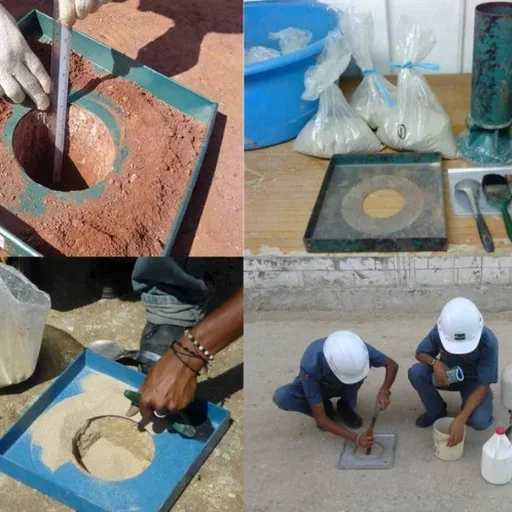
In Portlaoise, ground investigation governed by I.S. EN 1997-2:2007 is the starting point for any project where the boulder clay or limestone bedrock needs direct visual logging. An exploratory test pit in Portlaoise provides a physical window into the near-surface deposits, letting the geotechnical engineer measure bedding, record groundwater seepage at the rockhead interface, and collect undisturbed block samples. For the commercial developments expanding along the M7 corridor, skipping this step can miss a thin layer of soft alluvium that changes the bearing stratum entirely. We combine the test pit observations with supporting in-situ permeability testing when drainage design is critical, and the plate load test to verify bearing stiffness on the same excavated level, ensuring the foundation recommendation matches what the eye can actually see.
Seeing the contact between the boulder clay and the limestone bedrock in an open excavation removes the guesswork that borehole logs can sometimes leave behind.