GEOTECHNICAL ENGINEERING
PORTLAOISE
HomeLaboratoryGrain size analysis (sieve + hydrometer)

Grain Size Analysis (Sieve + Hydrometer) for Soils in Portlaoise

Practical geotechnics, field-tested.

LEARN MORE

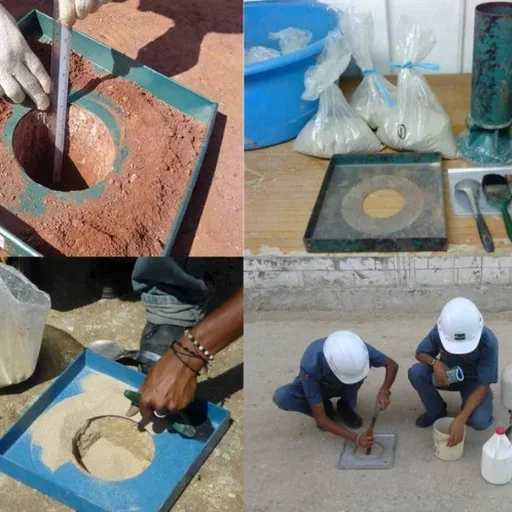
A commercial development on the Mountmellick Road hit unexpected silty layers at 2.8 m depth last winter—the contractor had assumed a well-graded gravel based on nearby boreholes. That assumption changed the foundation design entirely once we ran a full particle size distribution. In Portlaoise, where glacial tills and alluvial deposits mix unpredictably along the Triogue River corridor, relying on visual classification alone is a gamble. Our grain size analysis combines mechanical sieving for the coarse fraction and hydrometer sedimentation for fines passing the 63 µm sieve, giving you a complete curve from 75 mm down to 2 µm. We run this routinely under IS EN ISO 17892-4:2016, and the data feeds directly into drainage design, frost susceptibility checks, and compaction specs. For projects near the M7 interchange where imported granular fill is common, we often pair this test with an in-situ permeability assessment to verify drainage assumptions before placing stone columns or working platforms.

If you're only sieving to 63 µm and ignoring the hydrometer, you're blind to half the soil's behavior—especially in the glacial clays common across Laois.
Our service areas

How we work

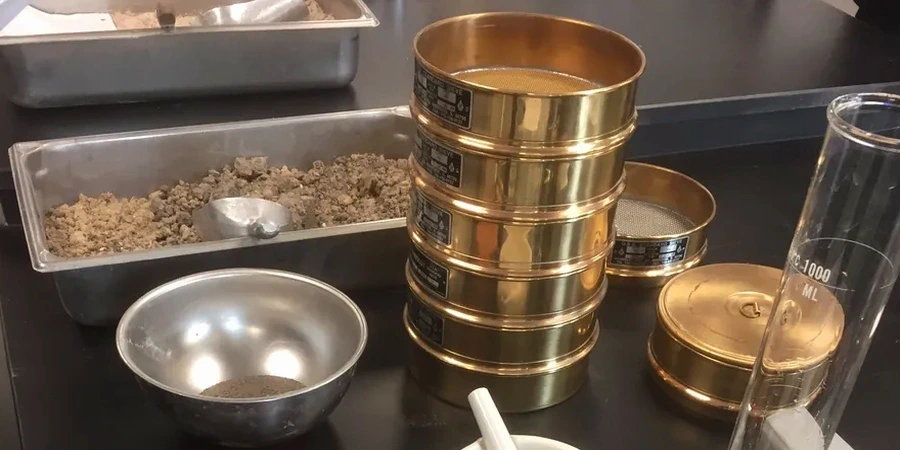
Portlaoise sits at roughly 130 m above sea level on a mix of limestone till and fluvioglacial sands—deposits that can shift from gravel to fat clay within 50 m laterally. That heterogeneity, common across the Irish midlands, makes a combined sieve and hydrometer analysis essential for any earthworks specification. We wash the sample through a 63 µm sieve, oven-dry the retained material, and run a full stack from 75 mm down to 63 µm per IS EN 933-1. The minus 63 µm fraction goes into sedimentation using a hydrometer calibrated at 20 °C, with dispersant and temperature corrections applied per IS EN ISO 17892-4. Results include D10, D30, D60, uniformity and curvature coefficients, plus the full grading envelope. On a recent warehouse pad near the Togher industrial estate, these coefficients flagged a gap-graded material prone to internal erosion—something standard sieve-only data would have missed. Where fines content exceeds 12 %, we recommend adding Atterberg limits to classify the cohesive fraction and predict volume change potential under the site's drainage regime.
Grain Size Analysis (Sieve + Hydrometer) for Soils in Portlaoise
Technical reference — Portlaoise

Local ground factors

Portlaoise's expansion from a garrison town into a midlands commuter hub has pushed development onto marginal land near the Triogue floodplain—ground where fine-grained alluvium and organic lenses sit within the upper 3 m. Without a complete grading curve including the clay fraction, you risk underestimating frost heave potential (particularly relevant given Ireland's winter wet-freeze cycles), misclassifying fill for earthworks per the NRA Specification for Road Works Series 600, or designing underdrainage that clogs within two seasons. We've pulled samples on the Stradbally Road that looked like sandy gravel in the field; the hydrometer revealed 18 % clay content, pushing the material into frost-susceptible category F3. That single data point changed the capping layer design from 300 mm to 450 mm of Clause 804 stone. The cost of the grain size test is negligible compared to removing and replacing a failed pavement structure because the fines behaved differently than assumed.

Need a geotechnical assessment?

Reply within 24h.

Email: contact@geotechnical-engineering.co

Regulatory framework

IS EN ISO 17892-4:2016 — Geotechnical investigation and testing: Laboratory testing of soil — Part 4: Determination of particle size distribution, IS EN 933-1:2012 — Tests for geometrical properties of aggregates — Part 1: Determination of particle size distribution (sieving method), NRA Specification for Road Works Series 600 — Earthworks (Ireland), IS EN 1997-2:2007 — Eurocode 7: Geotechnical design — Part 2: Ground investigation and testing (National Annex for Ireland)

Technical data

ParameterTypical value
Test standardIS EN ISO 17892-4:2016 (hydrometer); IS EN 933-1 (sieves)
Sieve range75 mm to 63 µm (mechanical wet-dry sieving)
Hydrometer range63 µm to 2 µm (sedimentation, 152H hydrometer)
Reporting parametersD10, D30, D60, Cu, Cc, % gravel/sand/silt/clay
Sample mass required500 g for fines-rich soils; up to 5 kg for granular fills
Turnaround time3–5 working days (expedited available)
AccreditationISO 17025 (INAB-accredited laboratory)

Common questions

How much sample do you need for a combined sieve and hydrometer test?

For most soils around Portlaoise we ask for at least 1 kg in a sealed bag. If the material is predominantly granular—say a Clause 804 aggregate—send 5 kg minimum to ensure enough plus-20 mm fraction for a representative coarse sieve. For silty clays typical of the Triogue floodplain, 500 g is usually sufficient. Keep the sample at its natural moisture content; we'll oven-dry a portion in the lab.

What does grain size analysis cost for a project in Portlaoise?

A standard combined sieve and hydrometer analysis runs between €110 and €190 per sample, depending on whether you need the full hydrometer sedimentation curve or just the sub-63 µm split. Volume discounts apply for earthworks projects submitting ten or more samples. The price includes the lab report with grading chart, coefficient calculations, and classification to IS EN ISO 14688-2.

Why can't I just do a sieve analysis without the hydrometer?

A sieve stack stops at 63 µm, so anything finer—silt and clay—ends up in the pan as a single 'fines' percentage. That tells you nothing about the clay fraction, which controls cohesion, permeability, frost heave, and shrink-swell behavior. In the glacial tills around Portlaoise, we regularly find 15–25 % clay content that a sieve-only report would lump as '12 % fines' and misclassify completely. The hydrometer separates silt from clay so your drainage and earthworks designs are based on real numbers, not assumptions.

How long does the test take from sample drop-off to report?

Routine turnaround is 3 to 5 working days. The sedimentation phase alone takes 24 to 48 hours because we need readings at specific time intervals per IS EN ISO 17892-4. If you're on a tight programme—say a pavement capping sign-off before the next rain front—we can expedite to 2 working days with prior arrangement. Sample collection in Portlaoise is available same day if we're already on site in the Laois area.

Location and service area

We serve projects in Portlaoise and surrounding areas.

View larger map