GEOTECHNICAL ENGINEERING
PORTLAOISE
HomeIn-Situ TestingField density test (sand cone method)

In-situ density testing for compacted fill across Portlaoise and Laois

Practical geotechnics, field-tested.

LEARN MORE

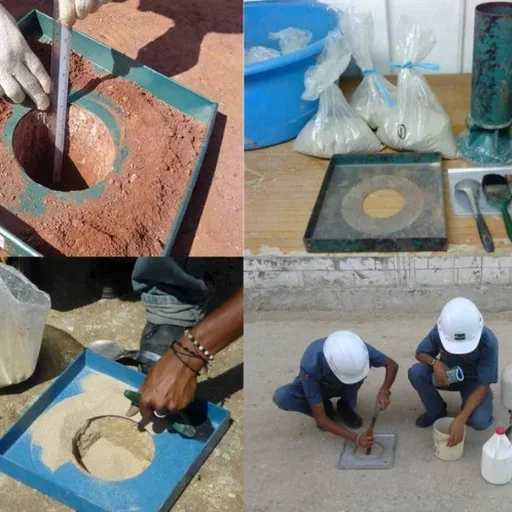
Portlaoise sits on a mix of glacial till and limestone-derived clays that can vary significantly across a single building plot. What looks like firm ground at surface level often masks soft lenses of silt just a metre down, particularly on the western side of town near the Triogue River corridor. The sand cone test gives us a direct, reliable measurement of in-place density in compacted layers — and around Laois, it is still the go-to method when contractors need proof that fill has been placed to specification. Because the county’s subsoil is so patchy, density values that pass a visual inspection can still fail a properly conducted field check. The plate load test is sometimes added when the client needs both stiffness and density data on the same formation, but for straightforward compaction verification the sand cone remains the most practical tool we deploy on residential and light commercial jobs.

In Laois till soils, a 2% moisture swing can drop compaction from 98% to below 95% — the sand cone catches that difference immediately.
Our service areas

How we work

The Irish midlands climate — damp winters, frequent drizzle, and a water table that rises fast between October and March — creates a particular challenge for field density work. Wet fill compacts differently than dry material, and in Portlaoise we often see crushed limestone sub-base that passes particle-size requirements but holds excess moisture from recent rain. The sand cone method uses a calibrated, free-flowing dry sand to measure the volume of a small excavation, so we have to be careful about hole stability in cohesive soils that smear during digging. Our team works to I.S. EN 13286-2 for unbound mixtures and checks moisture against the optimum from the laboratory Proctor curve, ensuring the field result is not just a number but a meaningful comparison against what the material can actually achieve under controlled conditions.
In-situ density testing for compacted fill across Portlaoise and Laois
Technical reference — Portlaoise

Local ground factors

Portlaoise has expanded steadily since the 1990s, with housing estates pushing into former agricultural land where topsoil stripping was sometimes minimal. When a developer takes over an old grazing field on the Timahoe Road or near the M7 retail parks, the subgrade often contains buried organic streaks that go unnoticed until density testing reveals erratic results. You can roll a smooth surface and pass a proof-roll, but if the organics compress later, the floor slab above will crack. A sand cone test on the first compacted layer picks up low-density zones before they get buried under subsequent lifts. In our experience across Laois, the most common source of dispute between contractors and design teams arises from assumed density values that were never verified in the field — and once the pavement or foundation is poured, fixing the problem costs ten times more than an extra test on the day.

Need a geotechnical assessment?

Reply within 24h.

Email: contact@geotechnical-engineering.co

Regulatory framework

I.S. EN 13286-2:2010 + A1:2012 — Unbound mixtures: Test methods for dry density and water content, Specification for Road Works Series 600 — Earthworks (Transport Infrastructure Ireland), I.S. EN 1997-2:2007 — Eurocode 7: Geotechnical design — Ground investigation and testing, BS 1377-9:1990 — In-situ density tests (where referenced in contract documents)

Technical data

ParameterTypical value
Applicable standardI.S. EN 13286-2:2010 + A1:2012
Calibrated sand gradeGraded silica sand, typically passing 1.0 mm, retained on 0.3 mm
Density cone opening16.5 mm diameter (standard 6.5-inch cone base plate)
Test depth range150 mm to 200 mm, adjustable for layer thickness
Minimum test frequency1 test per 500 m² per lift (Specification for Road Works Series 600)
Sample mass for moistureMinimum 200 g recovered from excavation
Report deliverablesField dry density, moisture content, relative compaction (%) and Proctor reference

Common questions

How much does a sand cone density test cost in Portlaoise?

For sites around Portlaoise, a single field density test with the sand cone method typically runs between €90 and €120, depending on access and the number of tests booked on the same day. A reduced rate usually applies when we are on site for a full shift of repeat testing.

How long does it take to get the density test results back?

We carry a portable moisture balance in the van, so density and moisture values are calculated on site within about 20 minutes. The formal PDF report with the Proctor curve overlay and compliance statement is emailed within one working day.

What if the ground is too wet for a sand cone test?

If free water seeps into the excavation before we can pour the sand, the test is invalid because the sand volume reading becomes unreliable. In those conditions we either wait for the water table to drop after a dry spell, switch to a different density method, or take a Shelby tube sample for lab density determination.

How many tests do I need for a house foundation in Portlaoise?

For a typical single-dwelling platform on compacted fill, the Specification for Road Works suggests a minimum of one test per 500 m² per lift. In practice, most engineers in Laois specify at least three tests per 150 mm layer across the footprint, with extra points near the edges where compaction rollers tend to miss.

Location and service area

We serve projects in Portlaoise and surrounding areas.

View larger map