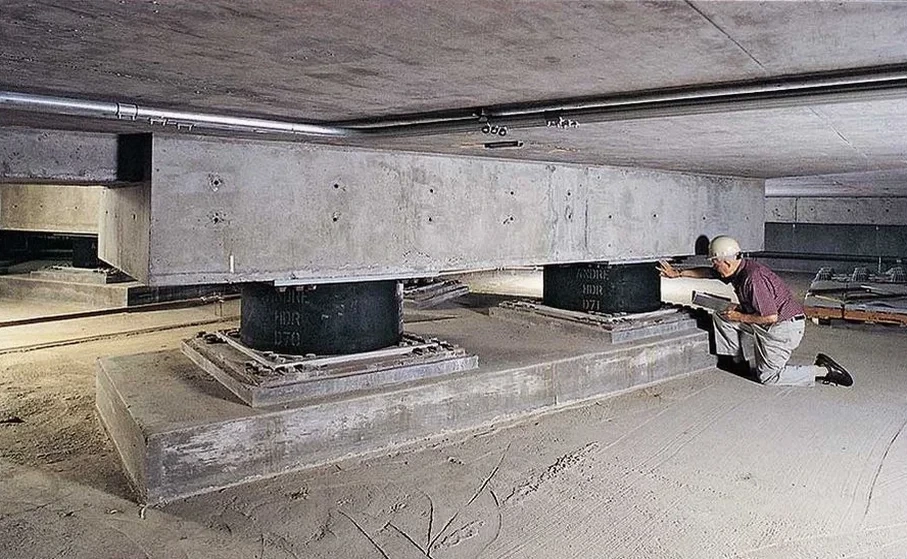
Portlaoise sits near 53.034°N, where the Irish National Seismic Network records low but persistent microseismicity linked to the Iapetus Suture zone. While Ireland lies outside active plate boundaries, the 1984 Llŷn Peninsula event (magnitude 5.4) was felt across the midlands, reminding engineers in Portlaoise that long-period ground motion can travel efficiently through the Carboniferous limestone bedrock. Base isolation seismic design inserts a flexible layer between the foundation and the superstructure so the building sees drastically reduced acceleration. For critical facilities in Portlaoise, from hospital wings to data halls, the technique transforms the seismic demand on structural elements, allowing service continuity even after a rare event. We model the isolator response spectrum using site-specific ground conditions, because blanket assumptions about seismicity here miss the amplification effects of glacial till over rock.
A well-tuned isolation plane in Portlaoise can cut inter-storey drift by 60–80%, keeping the building operational when conventional fixed-base designs would sustain damage.