GEOTECHNICAL ENGINEERING
PORTLAOISE
HomeGeophysicsElectrical resistivity / VES (Vertical Electrical Sounding)

Electrical Resistivity Testing (VES) in Portlaoise

Practical geotechnics, field-tested.

LEARN MORE

In Portlaoise, many site investigations overlook resistivity until it’s too late. You get borehole gaps between points and then find unexpected rockhead variation or a buried channel that the grid missed. We run VES surveys here because the glacial tills and limestone bedrock around the Triogue valley shift over short distances. A few soundings along the proposed alignment can save days of rework later. We’ve seen it on commercial builds near the M7 and on one-off housing sites west of the town centre where depth to rock jumped from 2 metres to 9 within 30 metres. When ground conditions are patchy, a CPT test gives continuous tip resistance and pore pressure data that complements the resistivity profile perfectly.

A VES sounding costs less than a day of drilling delays when rockhead isn't where the desk study said it would be.
Our service areas

How we work

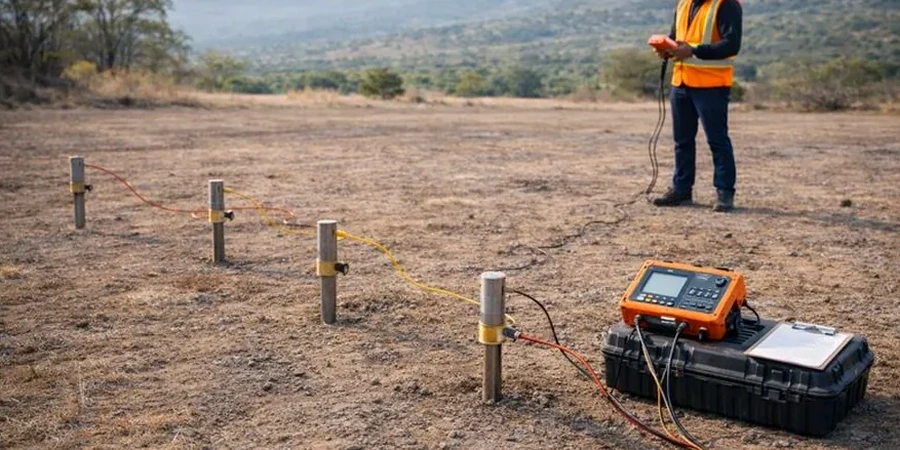
A common mistake is assuming a single resistivity line will map the whole site. The drift cover in Laois, with its mix of boulder clay and pockets of sand and gravel, creates lateral contrasts that one sounding cannot resolve. We set up Schlumberger arrays with expanding electrode spacing to build a 1D layered model at each VES point. Data inversion uses least-squares fitting and we cross-check with available borehole logs or trial pit logs from earlier phases. For sites where shallow refusal blocks dynamic probing, pairing VES with test pits that expose the top 3–4 metres gives us a hard calibration point for the resistivity interpretation. Shallow resistivity profiling also helps spot leachate plumes or old backfilled areas before you commit to excavation.
Electrical Resistivity Testing (VES) in Portlaoise
Technical reference — Portlaoise

Local ground factors

Sites north of the Triogue river often sit on thinner drift over weathered limestone, while the southern fringe towards Stradbally can hide deeper pockets of saturated gravel. The risk isn’t just misjudging depth-to-rock. A low-resistivity layer that looks like clay can turn out to be wet silt that collapses during trenching. If you skip VES, you’re left with isolated borehole data and no view of the gaps in between. We’ve seen foundation redesigns triggered by a single missed low-resistivity zone that turned out to be a soft infill channel. In karst areas near Portlaoise, resistivity anomalies may also flag cavities before they become a safety incident during piling or deep excavation.

Need a geotechnical assessment?

Reply within 24h.

Email: contact@geotechnical-engineering.co

Regulatory framework

IS EN 1997-2:2007 (Eurocode 7 – Ground investigation and testing), NSAI guidance on geophysical investigation methods, BS 5930:2015 (Code of practice for ground investigations)

Technical data

ParameterTypical value
MethodSchlumberger array, expanding electrode spacing
Depth of investigationTypically 20–60 m, site-dependent
Output1D layered resistivity model per VES point
InversionLeast-squares smooth or layer-based inversion
Spacing rangeAB/2 from 1.5 m to 150 m or more as needed
CalibrationBorehole or trial pit logs where available
Reporting standardEurocode 7 (IS EN 1997-2:2007) recommendations

Common questions

How much does a VES survey cost for a typical Portlaoise site?

For a single house site or small commercial plot with 3–5 VES points, budgets usually fall between €560 and €820. The range depends on access, electrode spread length, and whether we need to combine it with trial pit calibration.

What does resistivity actually tell me about the ground?

It gives you a vertical profile of apparent resistivity, which helps separate clay, silt, sand, gravel, and bedrock based on their electrical properties. In the Portlaoise area, high resistivity usually means dry gravel or limestone; low values point to clay, wet silt, or leachate.

How long does a VES survey take on site?

A single VES sounding takes roughly 30–45 minutes with a two-person crew. A survey of 4–6 points can be wrapped up in half a day, barring access issues or very long spreads.

Do you need boreholes to calibrate the resistivity data?

The reference range for this service in Portlaoise is €560 - €820. The final price depends on the project scope and volume.

Can VES replace a full ground investigation?

No. VES is a reconnaissance tool that fills gaps between boreholes. It won’t give you shear strength or consolidation parameters. We use it alongside SPT, CPT, or trial pitting to build a more complete picture without drilling everywhere.

Location and service area

We serve projects in Portlaoise and surrounding areas.

View larger map