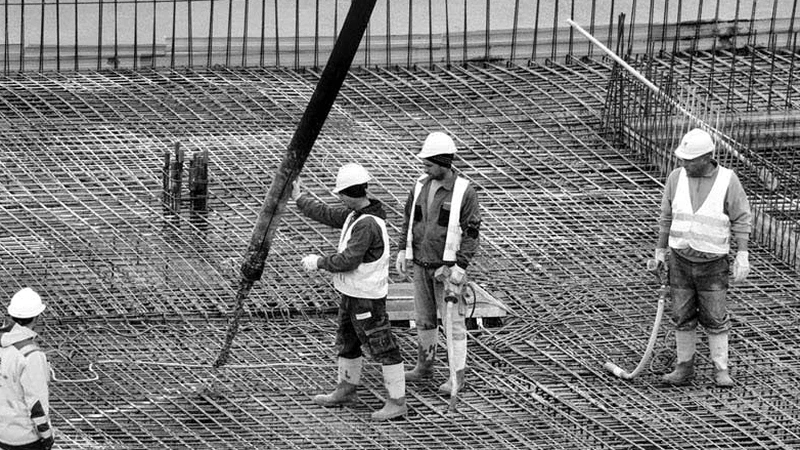
The subsoil profile across Portlaoise presents a challenging sequence of glacial boulder clay overlying pinnacled Carboniferous limestone, with isolated pockets of compressible alluvium along the Triogue River corridor. At the Mountmellick Road commercial developments, we have recorded undrained shear strengths below 45 kPa in the upper 2.5 metres, which directly drives the need for rigid raft solutions capable of spanning soft zones and bridging potential dissolution features in the underlying bedrock. A raft foundation design redistributes column loads across the entire footprint, reducing differential settlement to acceptable limits when bearing strata are inconsistent. Our technical team applies the observational method defined in I.S. EN 1997-1:2004, integrating site-specific stratigraphy with finite element modelling to determine slab thickness and reinforcement scheduling that accommodate both serviceability and ultimate limit states. The interaction between structural stiffness and variable ground in Portlaoise demands careful parameter selection, and we calibrate every model against in-situ permeability data where groundwater affects long-term consolidation behaviour.
A properly designed raft on variable Portlaoise till converts differential settlement from a structural threat into a manageable deformation within tolerable angular distortion limits.